Accommodations
You can use platforms like Expedia or booking.com to book hotels. We can offer recommendations on which hotels to choose and which ones to avoid.
Sofitel Ambassador Hotel

Sofitel Ambassador Hotel • 5-Star
Hotels near Sofitel
(Approx. $250/night)
- Hotel Muse Seoul
- The Ambassador Seoul
Jamsil Area Hotels
(Approx. $70-100/night)
5 min walking distance to concert venue (Sofitel Ambassador Hotel)

The Castle Jamsil • 2-Star

Orosie Tourist Hotel • 2-Star

Jamsil Delight Hotel • 2-Star


Gangnam Area Hotels
(Approx $100-150/night)
- Gangnam Family Hotel
- Hotel Cappuccino
15-20 min metro ride to Sofitel (the metro is very easy and affordable in Seoul)

Shilla Stay Samsung COEX Center • 4-Star

Hilton Garden Inn Gangnam • 4-Star

Best Western Premier Gangnam Hotel • 3-Star

AC Hotel Seoul Gangnam • 4-Star



Airbnb homes are located near the Sofitel. You can also search for accommodations close to attractions like Lotte World Aquarium and Seoul Sky.
Sightseeing
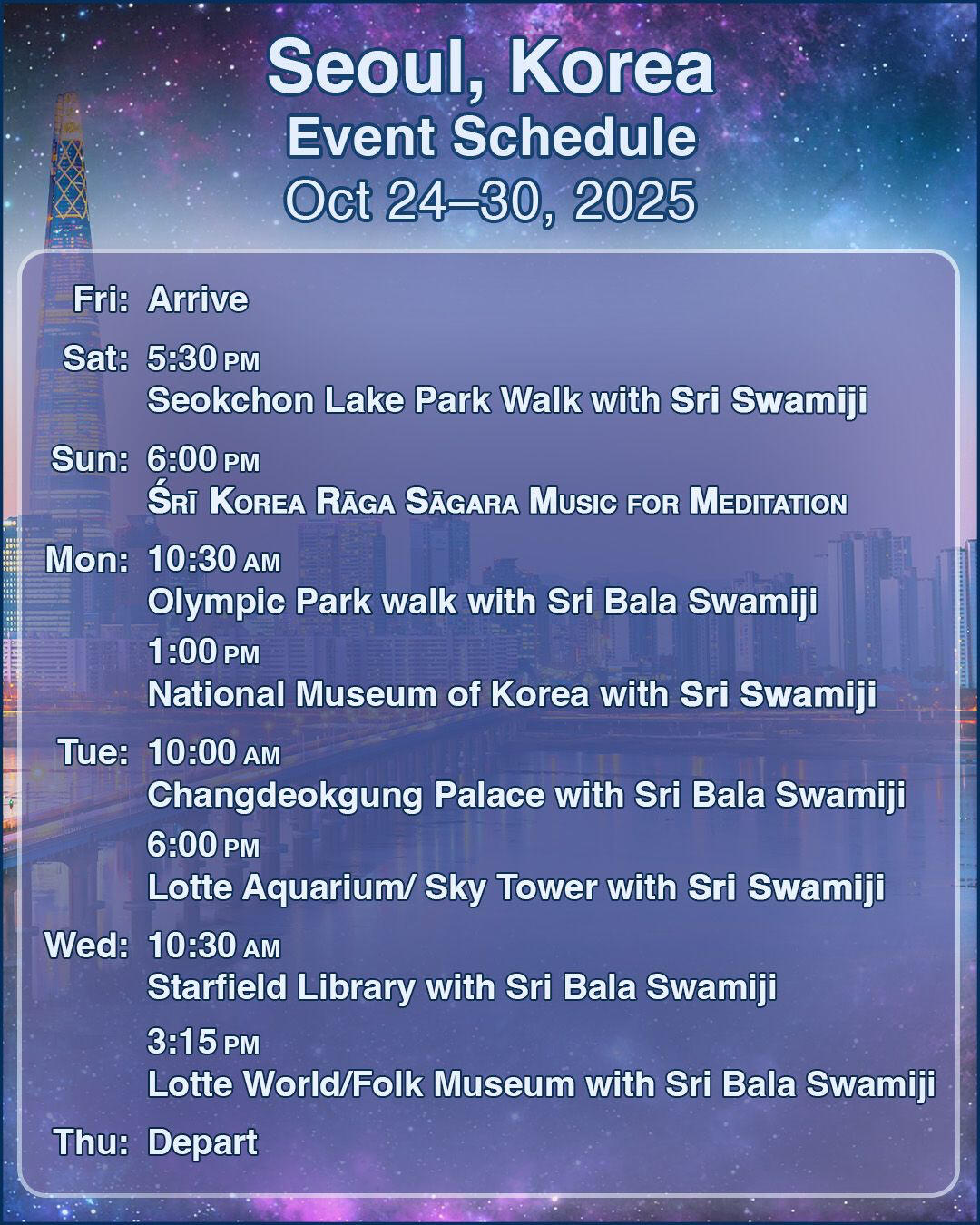
Sightseeing Details

1

2

3


Contact
Kaliji: +1 (310) 428-4119
Hari: +1 (540) 998-4858
Food
Indian Restaurants
Saravanaa Bhavan - 100% vegetarian restaurant (35-40 min from Sofitel)
Ganga, Agra, Kitchen of India - vegetarian options (5 min from Sofitel)
Vegan/Vegetarian
Rooted Seoul - 5 min from Sofitel
Plant Cafe Itaewon - 25 min from Sofitel
ALT.a (Michelin-rated Chinese restaurant) - 25 min from Sofitel
Plantude (COEX Mall) - 15 min from Sofitel
Mahina Vegan Table - 20 min from Sofitel
Visa
• India passport holders will need a visa to visit South Korea
Please click link below for application:
South Korea Visa Application
• USA passport holders do not need a visa to visit South Korea
• For other countries, check with the local Korean Embassy
Transportation
• Uber, taxi are easily available in Seoul
• Metro is the most affordable option and is easy to navigate
• From Incheon Airport: express buses are available to most hotel areas
Google Maps will only provide directions for public transportation in Korea (Metro, buses)
You can still search for location and estimate the directions (mostly for walking)*For full navigation - Use Apple Maps or download Naver Maps
(South Korea's navigation app) to get directions
Venue
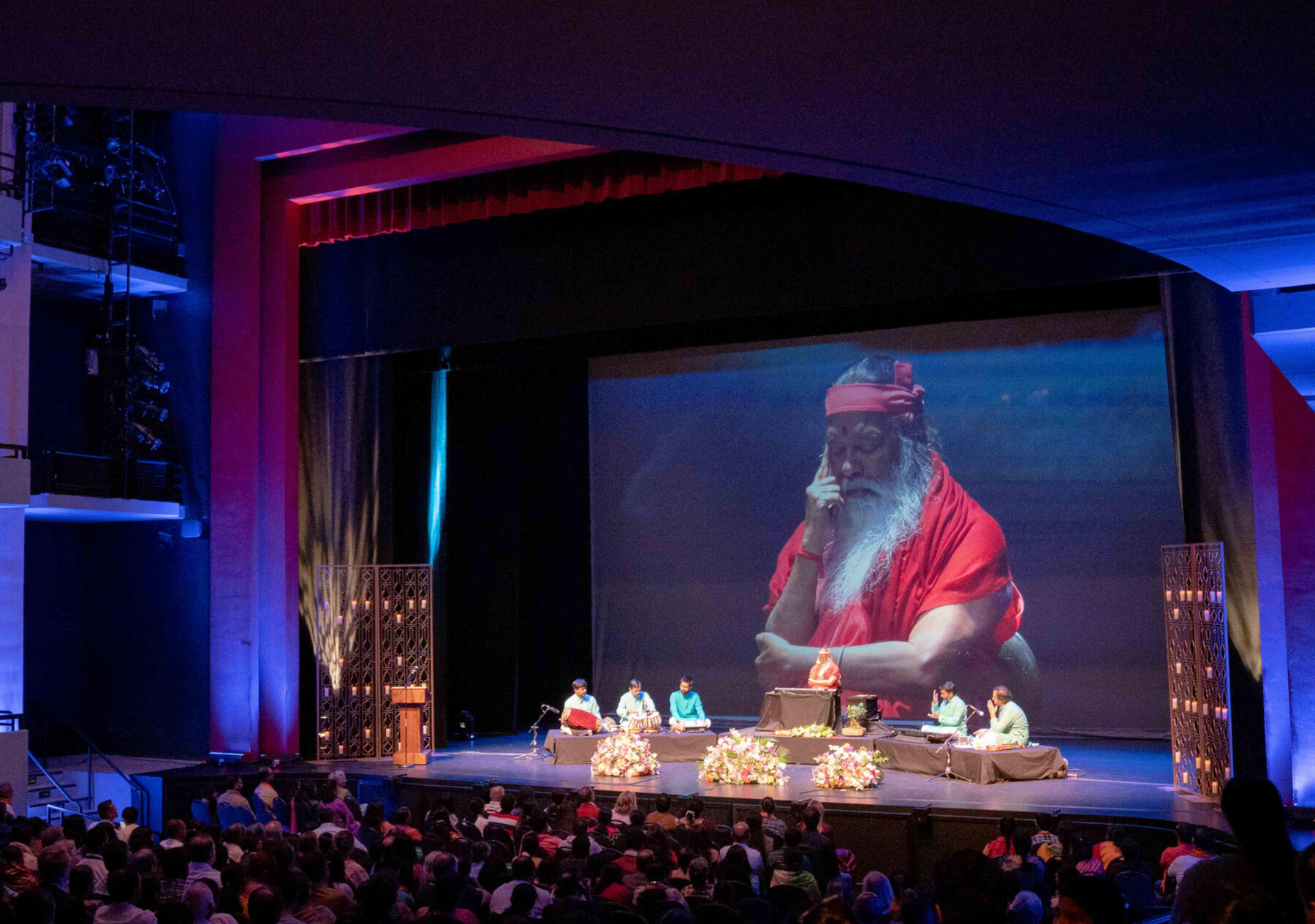
Sofitel Ambassador Hotel
★ ★ ★ ★ ★
209 Jamsil-ro, Songpa District, Seoul, South Korea
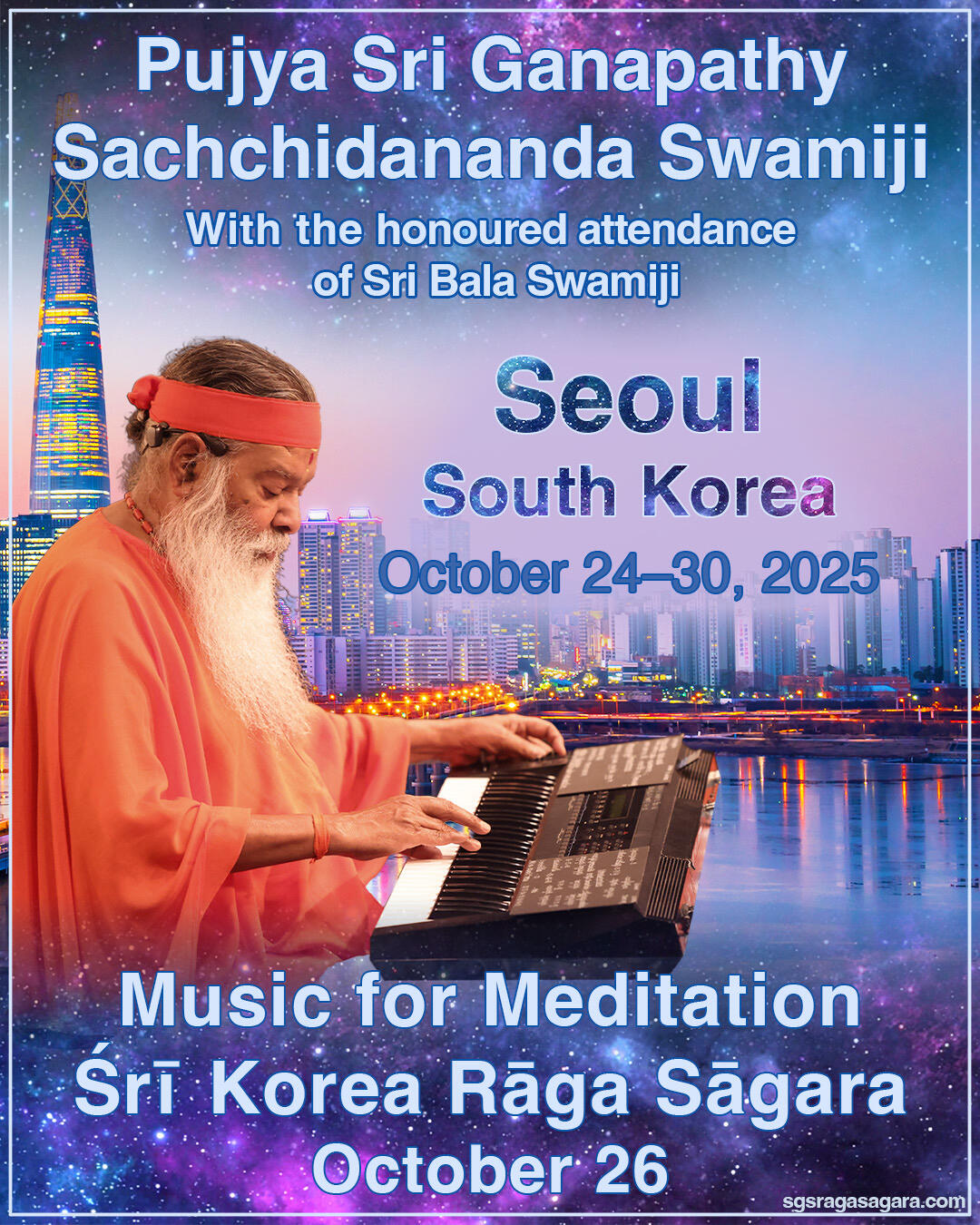
Seoul Schedule
• October 24
Sri Swamiji arrives in Seoul
• October 25, 27–29
Sightseeing
If Sri Swamiji wishes to join any sightseeing activities, the plans will be announced to all.
Devotees can then make their own arrangements to join.
• October 25
Evening walk around Seokchon Lake with Sri Swamiji
• October 26
Śri Korea Rāga Sāgara
Free Admission
Please reserve Here
to confirm attendance
• October 27
- Morning walk around Olympic Park Wildflower Garden
with Sri Bala Swamiji
- National Museum of Korea with
Sri Swamiji
• October 28
- Changdeokgung Palace with
Sri Bala Swamiji
- Lotte Aquarium with Sri Swamiji
- Sky Tower
with Sri Swamiji
• October 29
- Starfield Library with
Sri Bala Swamiji
- Lotte World/Folk Museum with
Sri Bala Swamiji
• October 30
Sri Swamiji will depart from Seoul
Music messages
Yogini Kaliji
to believe
without doubt or question
in the healing power of vibration
to know it
a fact as undeniable
as gravity
and sunrise
to feel vibratory power
to recognize and to harness it
this is what His Holiness
Sri Swamiji
represents
not only
the power of music to
heal
protect
and direct
but the ability
to harness its power
to share it
to shower its blessings
🔺
Sri Swamiji is a renowned spiritual leader, humanitarian, and prolific composer, singer, and musician. His compositions are carefully created soundscapes designed to elevate consciousness, soothe the mind, and promote healing. Many who experience his musical meditations report feelings of calm, clarity, and inspiration.
🔺
Sri Swamiji has performed at some of the most prestigious concert halls in the world, such as Carnegie Hall, Lincoln Center, Royal Albert Hall, and the Sydney Opera House. His widely available compositions continue to reach diverse audiences seeking healing and spiritual growth.
🔺
Hailing from India, the ancient land that has graced the world with some of the most prolific and elevated composers, Sri Swamiji shines in this light of excellence in music. He has composed several thousand compositions and is a prolific lyricist and poet. Wherever Sri Swamiji travels, His music is His Universal Language.
🔺
When Sri Swamiji says “music is my language,” He is not being symbolic. It is the way He communicates most directly, most clearly, most effectively.Like when one has been translating all day, and it’s a relief to slide back into the mother tongue, like that with music for Sri Swamiji—it’s direct…and divine.
🔺
Music brings us together. Music has the power to speak to the soul. Inspired composers are like channels that intuit the higher vibration of sound, manifesting it as song to inspire us, too. Such a composer is among us today in Sri Swamiji.
🔺
Although Sri Swamiji never underwent formal music training, He internalized and mastered music through yogic power. His music effortlessly flows to aid listeners in enhancing their concentration. When the sound is focused upon like a mantra, it has the most transformative effect, allowing one to become fully absorbed. This profound power of Nāda Yoga fosters spontaneous meditation. Sri Swamiji provides us with this incredible opportunity through His glorious music.
🔺
Sri Swamiji incorporates the concept of Nāda Yoga, which explores the role of sound vibrations in establishing a deeper connection with the Self. Nāda Yoga involves meditating on sacred sounds or music to calm the mind's thought waves. Sri Swamiji's music is often referred to as “Celestial Music,” due to its power to transcend ordinary states of consciousness and guide one into a meditative state.
🔺
The ancient science of Nāda Cikitsā are illuminated by the enchanting melodies flowing through Sri Swamiji. We bask in His Yogic Presence, listening deeply to the high-frequency music emanating from His carefully selected synthesizer sounds. Focusing on the music while letting thoughts fade will allow the vibrations to enter within, taking one on a journey into meditation where the mind calms and transcends worldly concerns.
🔺
Indian music has its roots in spirituality dating back to approximately fifteen-hundred to one-thousand BCE in the Ṛg Veda, a collection of hymns that were initially sung in monotone and later developed into three tones. In the Sāma Veda, additional notes were added to make the first seven-note scale, or rāga.
🔺
Between the fourteenth- and sixteenth- centuries, Indian classical music began to emerge. Yogis and saints often use music as their vehicle. As the great composer Beethoven said, “Music is a higher revelation than all wisdom and philosophy.” It is commonly said that when words fail, music continues.
🔺
Music Flows from Silence
“After silence, that which comes nearest to expressing the inexpressible is music.”
— a quote by Aldous Huxley
To experience the Supreme Silence, where all desires cease, bestows the universal feeling of oneness—the non-duality that is expressed through scripture and transcendental philosophy. Music emerges from Silence. Music returns us to Silence. Stokovski expressed it well: “A painter paints pictures on canvas. But musicians paint their pictures on silence.”
🔺
Music began on Earth before the human species entered with the sounds of ocean waves, leaves blown by wind, birds singing their songs, and animals with their diverse languages. Throughout humankind, the orchestra of nature draws people to relax, rejuvenate, renew; to heal as the mind calms; to touch the Silence. This is the essence of Nāda Yoga, the yoga of sound—also known as Nāda Cikitsā, sound healing.
🔺
Music accompanies our life journey from the first lullaby to the last song. On average, Americans spend 4.5 hours a day listening to music. Nietzsche, the German philosopher/composer, said “Life without music would be a mistake.”
🔺
Sri Swamiji is widely acclaimed for his profound ability to use music as a therapeutic and spiritual tool. For decades, he has traveled the world, sharing Music for Meditation and enhancing global understanding and experiences of music as therapy. His music serves as a transformative vehicle, aligning the body and mind with one's inner self.
🔺
Today music therapy is becoming more accepted as a healing modality due to the extensive research being done which proves the positive effects of sound on the body/mind, not only during the music session but even after the music has ended! Scientific research has observed that when the Indian classical music stimuli were removed, significant alpha brain rhythms continued.
🔺
Music has been used to treat many forms of disease ranging from Alzheimer’s to strokes to cancer. Owing to the recent scientific studies proving the ability of sound to create physical and cognitive changes and to evoke specific emotions, music therapy is seeing a rise today. There are more than 5,000 registered music therapists in the US alone. Yet this form of healing, also called nāda cikitsā, was taught during Vedic times.
🔺
With the advancement in music therapy two categories have been developed: medical music therapy (music with a trained music therapist) and music medicine (music with a patient). Tonight we will experience both as this renowned composer, a prolific artist with the full capacity for music expression, has done extensive research in the field of therapeutic music for the past 30 years and has released over 200 music CDs and videos. In this way, we have the complete music therapy experience, a master music therapist with a garden of music medicine!
🔺
The ancient music of Nāda Cikitsā will be illuminated by the enchanting melodies flowing through Sri Swamiji. We will bask in His Yogic Presence, listening deeply to the high-frequency music emanating from His carefully selected synthesizer sounds. Focusing on the music while letting thoughts fade will allow the vibrations to enter within, taking one on a journey into meditation where the mind calms and transcends worldly concerns.
🔺
Throughout the world, Sri Swamiji is recognized as a leader in therapeutic music. His healing music that combines ancient rāgas with new melodies, creating an ethereal experience for all. This music can transport the listener to subtler mental states, thus helping them experience enhanced relaxation, mental clarity, and spiritual inspiration.
🔺
Sri Swamiji is renowned for using “Rāga Raginī Vidyā” a form of music therapy that utilizes melodies or rāgas to resonate with the body's energy centers helping to restore balance while awakening spiritual energy.
🔺
Sri Swamiji has a profound understanding of the ancient music system of Rāga-Rāginī allows him unparalleled access to melodies, and he has even created new rāgas using this ancient system within present musicology. The vastness and impact of Sri Swamiji's music are unsurpassed, with compositions varying in emotional impact depending on the particular rāga's bhava and its relationship with the listener.
🔺
Rāga-Rāginī, as explored by Sri Swamiji through his music, aims to affect the nāḍīs, subtle pathways of energy, to vibrate at the proper frequency. Steadfast concentration on this meditative music calms the mind and makes music a therapeutic experience.
🔺
Sri Swamiji's specialized synthesizer, capable of producing over 1000 sounds, allows for a greater range of healing through music. His powerful, resonant voice, along with his divine musical inspiration, has graced over 200 CDs and DVDs, and his music can now be found in all forms of media. It captivates and nourishes the hearts and minds of those attuned to its vibrations.
🔺
Please understand, this is not ordinary music. It is not a concert. It is performed by one who has spent decades, like a scientist, experimenting with the application of sound for healing and meditation, one who embodies the sacred energy of divine music.
🔺
Sri Swamiji is a prolific composer with several thousand songs that have emerged from Him. A masterful singer and multi-instrumentalist, He specializes in the over 1,000 sounds His synthesizer is programmed with. Sri Swamiji may spend up to a month selecting the sounds for a particular piece. With such concentrated time in this form of music, He has mastered the ancient art of Rāga Rāginī.
🔺
To enter meditation through sound, one must concentrate on the music. The melodious rāgas and rhythms are so enticing that the thoughts will begin to flow in the same direction like rivers flow to the ocean. As the focus remains on the higher sound vibrations, the lesser thought vibrations dissolve, leaving one immersed in nādam prasara, the flow of healing sound.
🔺
All creation reverberates in sound. The whole universe moves as a symphony, each part vibrating, singing its own song. The thoughts of the mind are sound frequencies. Inside the physical body, it is a choir of sounds. The whole complex of body-mind is not only producing sound but also responding to sound.
🔺
It is said in the Vedas that God is Śabda Brahman. God and the sacred sound are inseparable. In the West, it is stated “in the beginning was sound.” But sound is also in the middle and in the end. We live in a circle of sound, a continuous cycle, like waves upon the ocean. Just as the waves flow away from the origin and return, sound waves emerge from Silence and sound waves will return us to Silence.
🔺
Music is organized sound waves and it has the power, due to its inherent vibration, to stimulate change. Research has shown that a strong beat results in sharper concentration and greater mental clarity due to brainwaves resonating in sync with the beat; whereas, a slower tempo inspires a calm, meditative state.
🔺
Research has also shown that music has lasting benefits. The change in brainwave activity that takes place while listening to music supports the brain to shift speeds more easily after the music session has ended.
🔺
What if we are listening to music composed by one with the intent to bring about meditative and healing changes? The impact would be great on our physical, mental, and spiritual well-being. This is the music of Sri Ganapathy Sachidananda Swamiji.
🔺
Listen from insidethe heartbeat,
the nerve impulses
even digestion is in rhythmall the other systems are melody
the rush and flow of liquids and solids
blood cells and muscle fibers
a fluid motion of melodyrhythm and melody are
science and art; logic and intuition yin and yang; sun and moon
🔺
energy consciousnesswhen they come together, it makes a trinityrhythm alone cannot entice
melody alone cannot sustain
together they make an arrow
an arrow that moves ~
🔺
Music has the power to change
because it is a cosmic duality
united in accessible form
it’s something everyone enjoyschildren, animals - all consciousnesses
respond to musicNow let the music move you.
🔺
Meditation and Healing Music awakens the listener to anāhata. Anāhata - the sound with no sourcea sense-less immersion into
nādam, pure sound, itself
to dive in and float on
waves of sound
🔺
music is math
vibration is energy
energy is the power to transform
🔺
To absorb the sound vibrations, let go of thoughts. It makes silence inside.In emptiness, new connections can be made
Must release; relax
and surrender
then something new can emerge
only in silence can a new sound be born
🔺
Sri Swamiji’s music is unusual - recognizable as music but also so unique -
Nāḍī surgery
that’s why sometimes Sri Swamiji says it is okay to sleep during the concert - easier to operate when the patient is unconscious.
🔺
Everyone responds to music without thinking, so it can manipulate, massage, and rearrange energy channels, bypasses conscious mind.
🔺
Not every sound is a melody
Not every movement a danceBut what speaks to the heart will rise up like a balloon of spirit.
🔺
As soon as the music begins, we can feel why Sri Swamiji chose sound
because it is most
direct —
bypasses thought and
goes straight to
mind
no interpretation
only experience
Master of ceremonies
Yogini Kaliji
Śrī Korea Rāga Sāgara
Seoul, South Korea
Sofitel Ambassador Hotel
October 26, 2025
Jaya Guru Datta
Greetings to our guests, friends, and devotees. A special welcome to Sri Bala Swamiji on his first visit to South Korea.Let’s see a show of hands: how many of you are attending Music for Meditation for the first time?Fantastic! We’re delighted to welcome you all.Before we begin, here are a few guidelines:Please set your mobile phones to silent mode.We kindly ask everyone to maintain a meditative silence to fully experience the healing vibrations of the music.If you need to exit or re-enter, please do so between musical pieces.We appreciate your presence and support. Let's create an atmosphere of harmony together.
*****
We're happy to have you join us for this special event dedicated to Music for Meditation, held for the first time in Seoul, Korea. We will embark on an inward journey through the compositions of Sri Ganapathy Sachchidananda Swamiji.In 2026, we will celebrate 40 years of Sri Swamiji presenting Music for Meditation. Tonight marks the 358th “Music for Meditation” event. “Concert” might not fully capture the essence of this musical mastery that elevates listeners into greater harmony and peace. It is a symphony of sounds that penetrate deep into the nāḍī system, elevating the prāṇa, or life force, to a higher frequency. It transcends the traditional concept of a concert. It is truly the music of the spheres.Just as there are many paths to the top of a mountain, there are countless ways to calm the mind. However, one of the most direct paths is through the sound of sacred music. It has the unique ability to captivate us, allowing us to leave behind our worldly desires.In the quieting of the mind, music replaces our thoughts and reveals the light of consciousness. Allow yourself to be absorbed by the music, embracing the opportunity to merge with its transcendental sound. Let the music transport you to other realms, as many have testified that this has happened to them when they focus entirely on the new sound.As you listen, we invite you to let the music flow through you. Focus on the sound. You can sit as if in meditation or simply relax. If your mind wanders, gently bring your attention back to the mystical sounds.Let the waves of sound vibrations embrace, heal, and inspire you.We are blessed to experience this divine gift of sound from Sri Swamiji. Let's fully immerse ourselves in Music for Meditation.Now, let's all rise and warmly welcome the spiritual leader of Avadhūta Datta Pīṭham, Pujya Sri Ganapathy Sachchidananda Swamiji, on His first visit to South Korea!Jina Lee will present a garland to Sri Swamiji.I'm delighted to introduce the musicians accompanying Sri Swamiji, known as the Celestial Message Troupe:—Vidvan Jaitra Varaṇāsī on violin
—Vidvan Maṇi Narasiṃham on keyboard
—Vidvan Śaṅkar Ramesh on mṛdaṅgam
—Vidvan Manjunatha Rajappa on tablā
—Vidwan Vasudev Dash on support keyboardWe invite Sri Swamiji to guide us on the inner journey of the Śrī Korea Rāga Sāgara.
~~~~~~~~~~~~~~
Conclusion of Music for Meditation:We extend our heartfelt gratitude to Sri Swamiji for the blessing of Śrī Korea Rāga Sāgara.Dong-jin and Jina will offer the concert vastram and garland to Sri Swamiji.Narayana Gopinath will present the Devi Bhajans master disk.Kaliji will release the master disk recorded at HamSa, Sri Swamiji’s recording studio in the USA.Honoring the artists will be Dong-jin, Ji-won Oh, and Soon Min Kim.Vidvan Jaitra Varaṇāsī
Vidvan Maṇi Narasiṃham
Vidvan Śaṅkar Ramesh
Manjunatha Rajappa
Vasudev Dash
인도명상음악호 서울,
대한민국 환영사
Śrī Korea Rāga Sāgara
서울 한국
서울 소피텔 앰배서더 호텔
2025년 10월 26일
자야 구루 닷따 (Jaya Guru Datta)
존경하는 내빈 여러분, 친애하는 친구들과 귀빈 여러분,그리고 오늘 처음으로 한국을 방문하신 스리 발라 스 미지(Sri Bala Swamiji)께 진심으로 환영의 말씀을 드립니다.이 자리에 계신 여러분 중에서 ‘명상을 위한 음악(Music for Meditation)’ 행사에 처음 참석하신 분 손들어 주시겠습니까?아주 훌륭합니다!여러분 모두를 진심으로 환영합니다.시작에 앞서 몇 가지 안내 말씀을 드립니다.휴대전화는 무음 모드로 설정해 주시기 바랍니다.음악의 치유적 진동을 온전히 체험하기 위해명상적 침묵을 유지해 주시기 바랍니다.부득이하게 출입하셔야 하는 경우, 곡과 곡이 끝나는 사이에 이동해 주시기 바랍니다.여러분의 참여와 성원에 감사드리며, 오늘 이 자리가 조화로운 에너지의 장이 되기를 바랍니다.
***
오늘은 서울에서 처음으로 개최되는 ‘명상을 위한 음악(Music for Meditation)’ 특별 행사에 함께해 주신 여러분께 진심으로 감사드립니다. 우리는 오늘 스리 가나파티 사치단난다 스와미지(Sri Ganapathy Sachchidananda Swamiji)의 작품을 통해 내면으로 향하는 여정을 시작하게 됩니다.다가오는 2026년은 스와미지께서 ‘명상을 위한 음악’을 선보이신 지 40주년이 되는 해입니다. 오늘은 그 여정 중 375번째에 해당하는 공연입니다. 그러나 “콘서트(concert)”라는 단어는 이 음악의 본질을 다 담아내지 못합니다. 이것은 단순한 연주가 아니라, 청중의 프라나(prāṇa)를 고양시키고 나디(nāḍī)를 진동시키는 신성한 조화의 교향곡입니다. 그것은 바로 우주의 음악, 천상의 소리입니다.산 정상으로 오르는 길이 여러 갈래이듯, 마음을 고요히 하는 방법도 셀 수 없이 많습니다. 그러나 그중 가장 직접적인 길 중 하나는 성스러운 음악의 소리입니다. 그 소리는 우리를 사로잡아 세속적 욕망에서 벗어나도록 이끕니다.마음이 고요해질 때, 음악은 우리의 생각을 대신하여 의식의 빛을 드러냅니다. 그 음악에 온전히 자신을 맡기십시오. 소리의 세계 속으로 녹아드는 그 순간, 당신은 초월적인 진동과 하나가 될 것입니다. 많은 이들이 증언하듯, 음악에 완전히 몰입할 때 다른 차원의 세계로 이끌려 가는 체험을 하게 됩니다.이제 음악이 여러분을 통과하도록 허락하십시오. 오직 소리에 집중하십시오. 명상하듯 앉으셔도 좋고, 편안히 휴식하셔도 괜찮습니다. 만약 마음이 산만해진다면, 부드럽게 다시 그 신비로운 음향으로 돌아오십시오.소리의 파동이 여러분을 감싸고, 치유하며, 영감을 불어넣도록 하십시오.W오늘 우리는 스리 스와미지로부터 이 신성한 소리의 선물을 받을 수 있는 귀한 축복을 누리고 있습니다. 그 은혜로운 순간 속에 온전히 몰입합시다.이제 모두 자리에서 일어나, 아바두타 닷따 피탐(Avadhūta Datta Pīṭham)의 영적 지도자 푸자 스리가나파티 사치단난다 스와미지(Pujya Sri Ganapathy Sachchidananda Swamiji)를 그분의 첫 번째 대한민국 방문을 기념하며 따뜻하게 맞이합시다!이제 이진아님과 오동진님께서 스와미지께 화환과 숄을 봉정하겠습니다.이제 스와미지를 모시고 함께할 천상의 음악단, Celestial Message Troupe의 연주자들을 소개하겠습니다.—비드완 자이트라 바라나시(Vidvan Jaitra Varaṇāsī) – 바이올린—비드완 마니 나라심함(Vidvan Maṇi Narasiṃham) – 키보드—비드완 상카르 라메쉬(Vidvan Śaṅkar Ramesh) (므리당감, mṛdaṅgam) – 음북—비드완 마누자나타 라자파(Manjunatha Rajappa) – 타블라(tabla)—비드완 바수데브 대시(Vidwan Vasudev Dash) – 보조 키보드이제 스리 스와미지께서 우리 모두를 ‘Sri Korea Rāga Sāgara’의 내면적 여정으로 인도해 주시겠습니다.
~~~~~~~~~~~~~~
《명상을 위한 음악》의 마무리
이제 깊은 감사의 마음으로 스리 스와미지께 ‘Sri Korea Rāga Sāgara’의 축복을 진심 어린 감사를 올립니다.오동진님(Dongjin Oh)과 이진아님(Jina Lee)이 스리 스와미지께 음악회용 바스트람(의복)과 화환을 봉헌합니다.나라야나 고피나뜨님께서 데비 바잔스(Devi Bhajans) 마스터 디스크를 헌정합니다.깔리지께서 미국의 스리 스와미지 녹음 스튜디오 함사(HamSa)에서 녹음된 마스터 디스크를 공개하겠습니다.예술가들에 대한 감사의 표시로 오동진(Dongjin Oh), 오지원(Ji-Won Oh), 김수민(Soo-min Kim) 이 세 분께서 공연자들을 예우하겠습니다.—비드완 자이트라 바라나시(Vidvan Jaitra Varaṇāsī)—비드완 마니 나라심함(Vidvan Maṇi Narasiṃham)—비드완 상카르 라메쉬(Vidvan Śaṅkar Ramesh)—비드완 마누자나타 라자파(Manjunatha Rajappa)—비드완 바수데브 대시(Vidwan Vasudev Dash)